Time to Let LLMs Rewrite Your LLMs? Not So Fast.

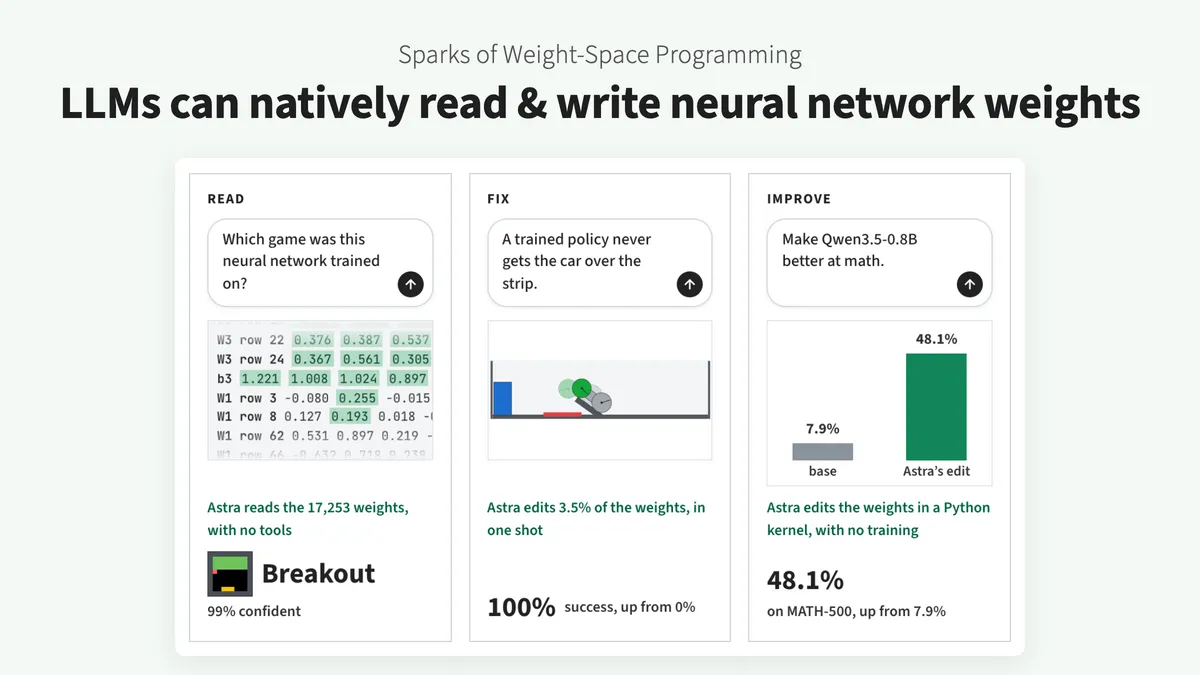
A research blog post from MIT took the community by storm last week. “Weight-Space Programming” shows that frontier models are actually pretty good at reading and modifying model weights. Pretty big deal if one AI can customize and improve another through reasoning, without needing a huge data center.
The most impressive result? Astra (OpenAI’s top model) substantially improved a small Qwen model’s math benchmark performance by directly editing just 0.016% of its weights.
Why Weight-Space Programming?
Most of us use off-the-shelf models, while relatively few run models locally.
This cool research raises some interesting questions.
What if intelligence itself were as malleable as software? Could your team customize and run much more cost-efficient models without hiring highly sought-after specialists?
What if you could inspect and audit models just like the rest of your systems, understand how they were trained, and check for backdoors and other threats?
What if this helps us reach the holy grail of AI: recursive self-improvement?
Should you stop paying for expensive tokens and switch to customized, state-of-the-art open-weight models? I wish I could advocate for that, but no—not without a closer look and a lot more work.
What’s Actually New Here?
As the authors themselves acknowledge, these are very early results. Exciting, certainly, but researchers are divided on their significance.
Neel Nanda from Google DeepMind suggests that the techniques involved (mechanistic interpretability, his area of expertise) are already well known and likely part of Astra’s training data. The bigger question is whether these techniques can scale to the complexity of modern LLMs. That said, the biggest takeaway is just how capable frontier LLMs like Astra have become, potentially unlocking many practical applications.
Rather than genuinely improving intelligence, the Qwen experiment is closer to fixing a known issue in Qwen3.5-0.8B, where the model gets stuck in a reasoning loop without producing a final answer.
There are already related techniques that serve as practical solutions for specific use cases. For instance, ablation involves disabling or removing parts of a model to study their effects, while abliteration aims to “uncensor” LLMs without retraining, as illustrated by Audrey Tang’s work customizing DeepSeek.
What’s new is showing that LLMs can be surprisingly good at driving such edits.
It’s exciting to imagine Weight-Space Programming taking off, but these new capabilities also raise new concerns.
New Challenges
In this case, a tiny change to the model’s weights produced a huge effect. Today, models undergo extensive benchmark evaluations and safety testing. When we customize these models, can we reproduce the same level of assurance and provenance checks? In regulated industries such as finance, humans remain accountable even when AI systems make the changes.
Benchmark-maxxing also tells only a small part of the story. Scoring higher on math benchmarks doesn’t necessarily make a model more intelligent, and optimizing for them could even hurt performance in real-world applications.
Could distributing your customized model expose its training data? This research demonstrates that LLMs can infer which video games a model was trained to play from its weights—raising questions about what else could be inferred from models customized with proprietary data.
Our Takeaways
Back to Evals. If you can’t measure it, you can’t improve it. And as Knuth famously warned, premature optimization is the root of all evil. We’re tempted to fine-tune models, and now even create new ones. But it’s crucial to first understand our tasks and objectives and establish rigorous benchmarks.
Make AI Systems Legible to Humans. We’ve grown used to treating LLMs as black boxes, but they don’t have to be. The blog post also points to ongoing interpretability research, such as Google DeepMind’s work on compiled transformers. There’s plenty of low-hanging fruit in making agentic systems more understandable and containing their complexity and unknowns—from better specs to observability tools—so we don’t end up with slop.
Once again, exciting times. With AI, building has never been more empowering—or more challenging.